
Through a Kaleidoscope
A Solo Exhibition at the Torch Theatre in Milfod Haven. Through a Kaleidoscope, includes a series of circular carvings in relief, in oak wood and their accompanying drawings.
6th May – 30th May 2026
Through a Kaleidoscope,
includes a series of circular carvings in relief, in oak wood and their accompanying drawings.
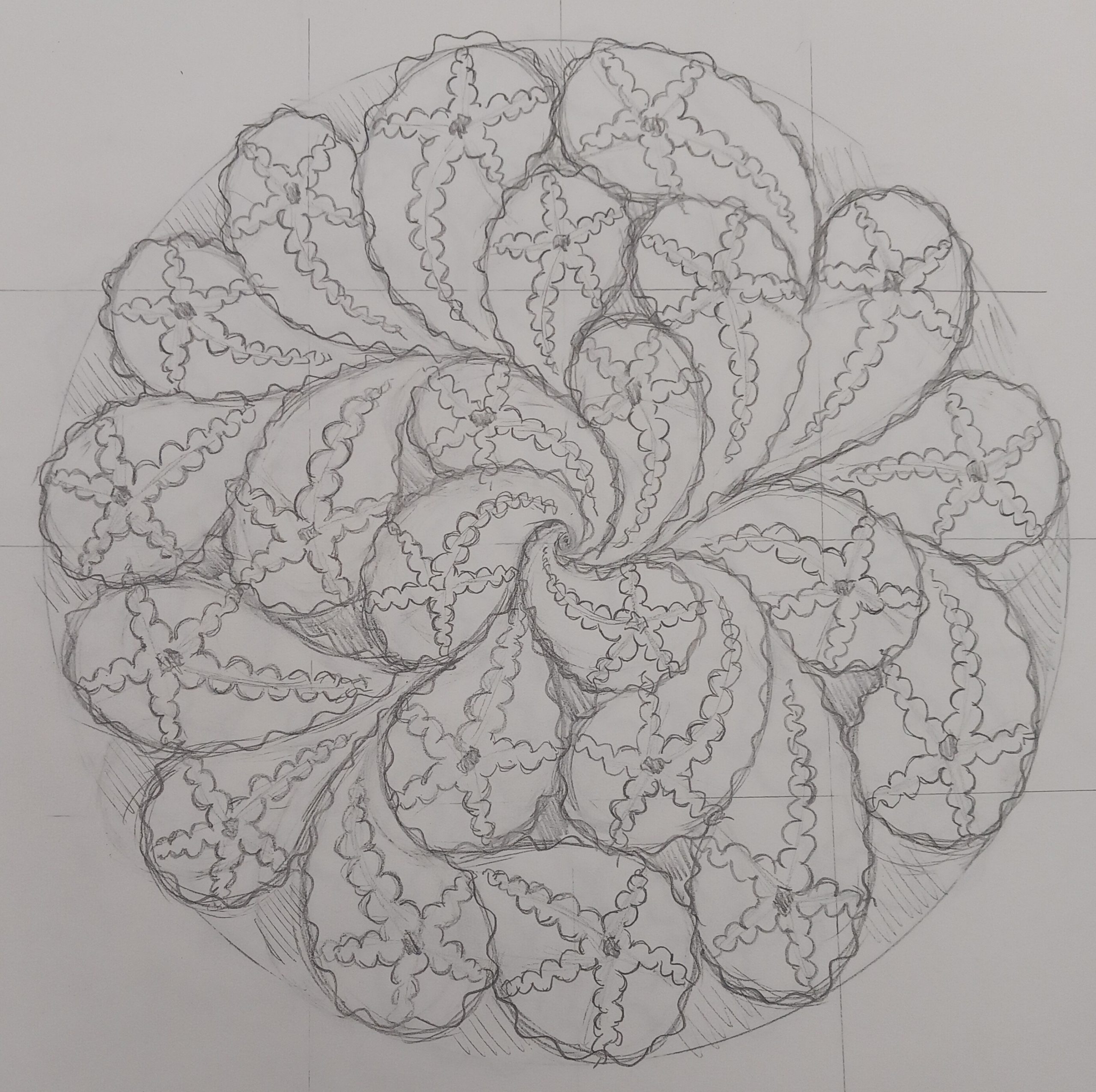
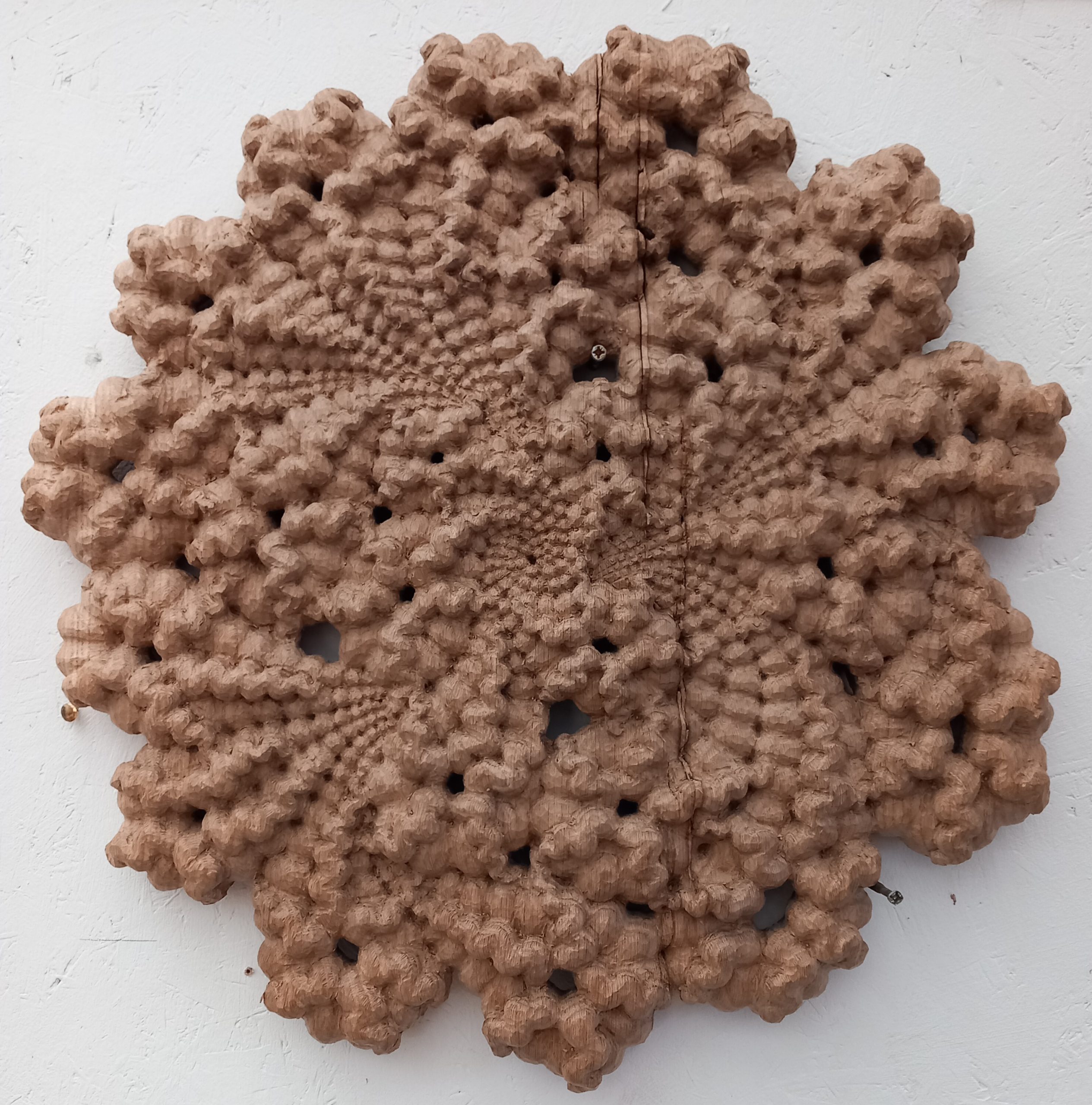
Unlike most relief carvings that bear a striking resemblance to their original drawings, this group of carvings do not look like the drawings they are based upon, although they are composed of the same elements which are directly transferred to the timber. What is represented in the drawings differs completely from what is presented in the carvings.
In these particular carvings an unusual transformation happened during the process of carving. The title of the exhibition. Through a Kaleidoscope derives from this transformation. Initially the carvings appear as a tangled mass of stuff but on further scrutiny the underlying structure is revealed with its covering layer of flamelike details.
In each new drawing and carving, forms and details are arranged into different configurations and assemblages of asymmetrical interlocking shapes, creating kaleidoscopic effects in the variety of meetings and partings spreading throughout the compositions. Like the pieces inside a kaleidoscope, the forms and details in themselves that make up the composition of the carvings are unremarkable, repetitive and in flux, but when placed in different alignments they take on whole new appearances.
The drawings are linear, they appear very flat, and are defined by the clarity of the asymmetrical patterns and details. Once these forms are carved in 3D we are only left with the sensation of the design. The 3D nature of carving changes the relationships and appearance within the composition, creating a completely different feeling to the drawings. The linear current and tension running through the 2d drawings retreats, and is replaced by fleeting effects of light and shadow across clusters of bumpy forms creating something evolving, more fluid, fleeting and insubstantial.
Assuming a completely different character to the drawings, the clusters of bumpy forms in the carvings, spread out into lyrical whisps of forms or are concentrated into short bursts of dynamic energy.
This final appearance of the carving cannot be predicted in the drawing and only comes out through the slow process of carving, creating different harmonies in the patterns of light, shadow and movement within the carving. The entire surface seems to boil and pulse with a whole new purpose.
Resemblance and intention
These carvings are not about the resemblance to, or an imitation of, any specific thing.
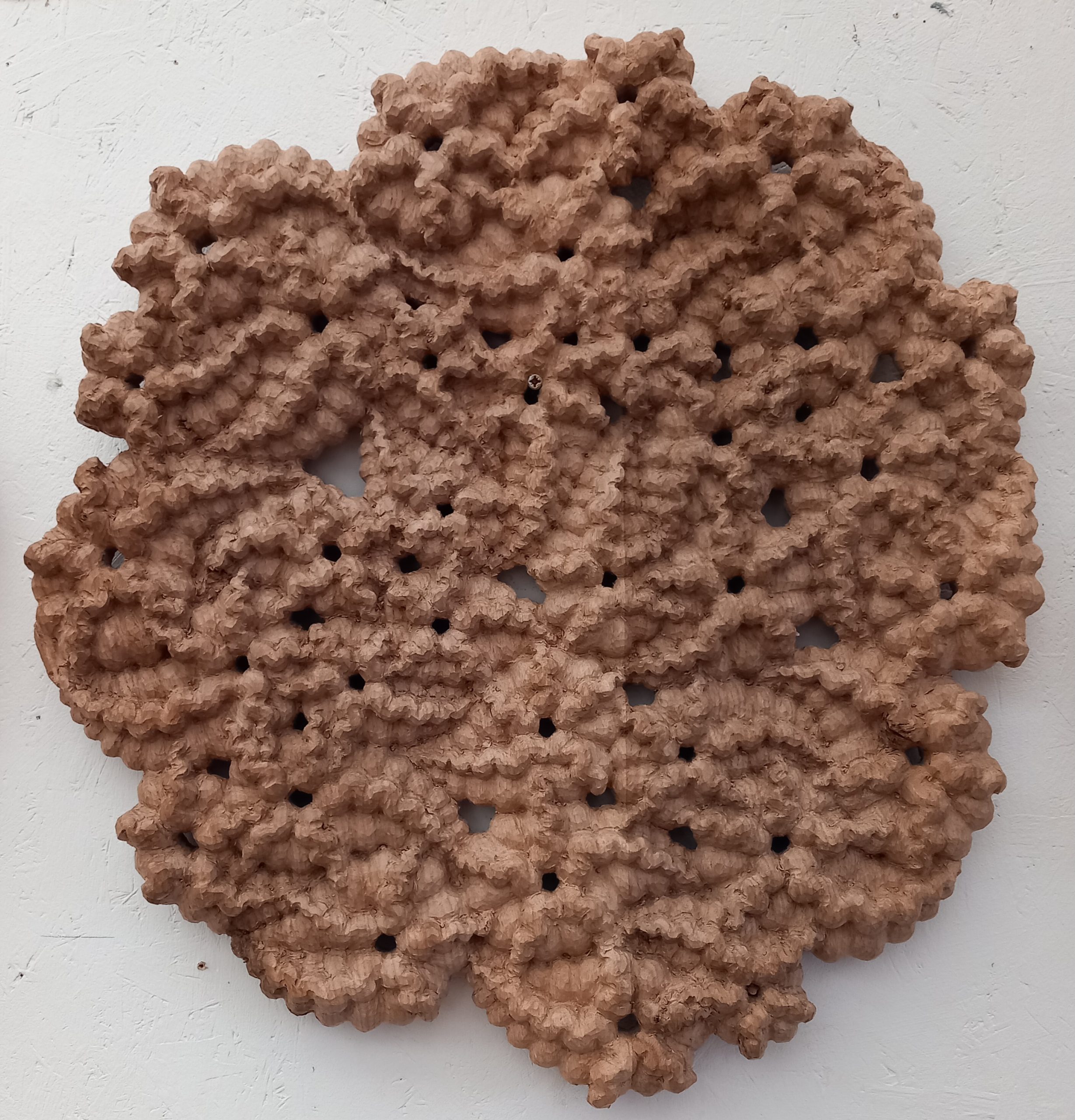
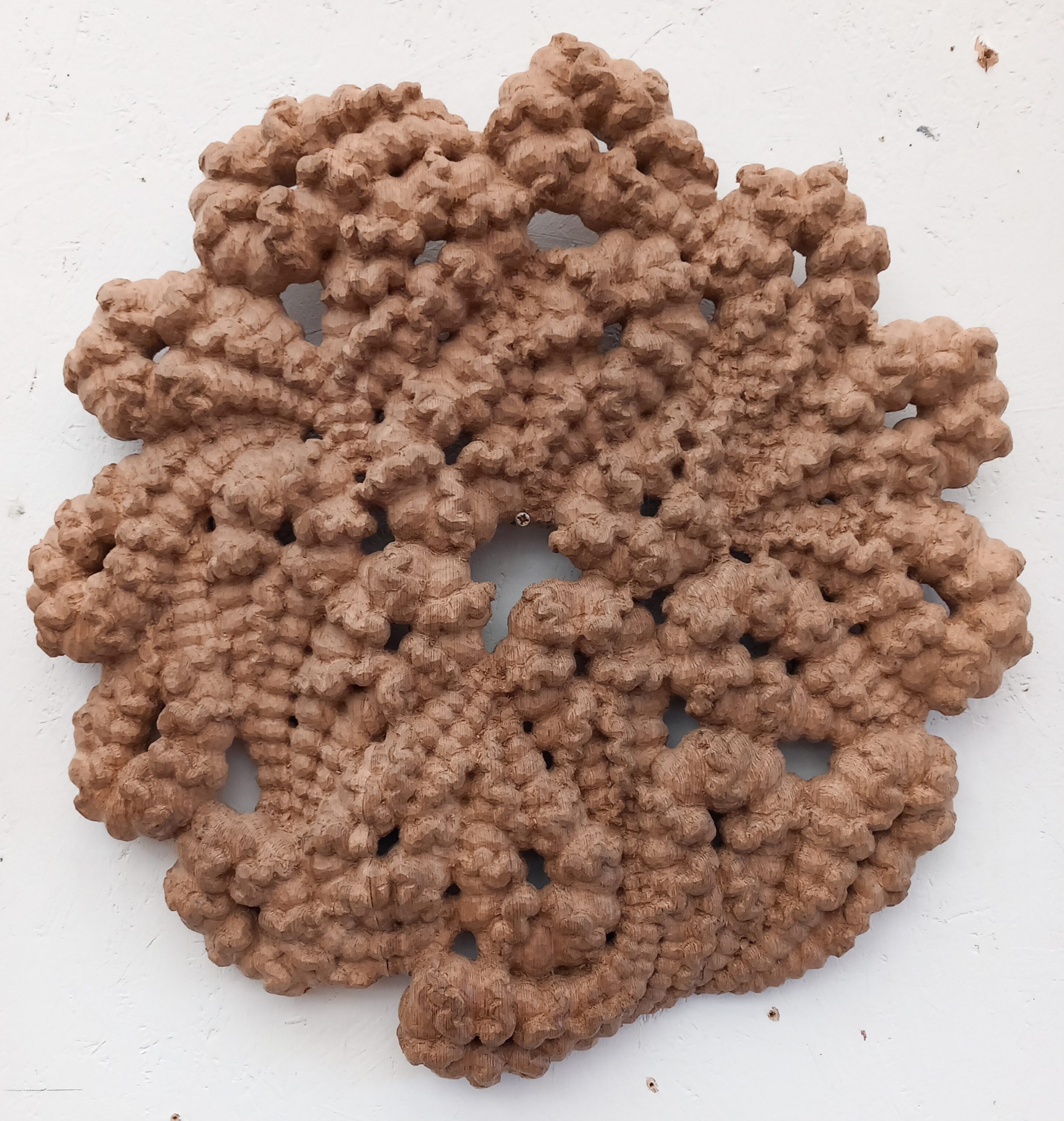
The carvings may be similar to many things, someone suggested that they have a resemblance with the knotted patterns of crocheted doilies or resemble biscuits. They also may be analogous with the interior forms of flowers and although these things are similar, none of this is intentional.
The work has many visual influences from the heavily eroded sedimentary rocks at low tide on Broadhaven South to the rhythm of the carved mouldings in the Norman arches of St Davids Cathedral and the interlocking shapes found in the intricate tracery of cathedral rose windows. In the play of simple geometric patterns of the vaulted cathedral ceilings, in the tiny units that compose the beautiful and elaborate stucco domed ceilings of the Alhambra Palace and in the stunning geometric patterns decorating Islamic buildings.
The carvings are intended to resemble the experience stimulated by the above influences rather than a likeness to them. They refer to the dynamic energy and equilibrium; we experience from the above, viscerally as a play of energy as much through our bodies as through our eyes. We do not hear the above influences, but their effect upon us is similar to music.
So, what are the carvings meant to be about? The individual forms are not meant to be interesting or beautiful, but they are meant to be doing something. The intention is to generate speed and motion by their differing alignments, it is not about where they are going, it is that they are going, that they are in constant flux. The pierced flaming star like details radiating from the centre of the main forms, are there to animate the composition with short bursts of energy, like increasing the tempo in a piece of music and are not meant to be lovely details.
The resemblance is more about an equivalent to the experience of music, similar in effect to the play of sounds that make up a musical score. The carvings are about a play of forms making up a composition and the common essence of both, is a play of energy. And like music, the play of energy varies in each new piece where the forms are realigned into new configurations, with differing visual weights. The details, unevenly distributed across the design, underscores and makes each piece different in feeling. Rather than imitating any specific thing, these carvings are trying to create an equivalent of motion and gesture and release of energy, the activity of the forms may be concentrated, reduced or expanded, speeded up or slowed right down, like the notation of a piece of music.
Would you like to see more work?
You can see more of Anthony's work and the work of his students in the other galleries by clicking the link below.